Sediment growth is a very big challenge in natural and industrial phenomena. In this research, in order to answer this challenge, simulation of sediment layer growth is done. For this purpose, the flow parameters in this problem are calculated using Euler's method. Also, in order to follow the particles with high accuracy up to near the surface, the Lagrangian method is used. In this research, due to the use of the immersed boundary method, the common error of negative volume was not encountered in moving networks, and also because of the use of this method and the lack of network reproduction. In each time step, it has a 30% reduction in calculation cost compared to the moving grid method. With the aim of evaluating the strength of the developed model for validation, the pipe was used against the flow where the soot particles are deposited on its front. Finally, various parameters such as Young's modulus, flow Reynolds number and diameter distribution of different particles will be investigated.
The sedimentation phenomenon is defined as the settling of particles and their accumulation on the surface, which starts with the settling of only one particle on the surface and in some cases can completely block the flow path. Therefore, the growth of the sediment layer can impose many economic and functional problems on the system. Among these problems, we can mention the increase in pressure drop (use of stronger pumps) and decrease in heat transfer coefficient (increase more fuel). Therefore, due to the importance of the subject and the existence of research gaps in different parts of this process, researchers have studied the deposition and growth of this layer numerically with different methods. In general, the researches conducted in this field can be divided into two categories: zero-dimensional model (analytical and semi-experimental model) and numerical model, which summarize the complex physics of this phenomenon in two processes: sedimentation rate and sediment removal rate. And the difference between these two parts determines the sedimentation rate.
Analytical and Eulerian methods to simulate the growth of the sediment layer will face a fundamental challenge in calculating the turbulence parameters such as the dimensionless distance due to the lack of a physical boundary. On the other hand, moving mesh methods have high computing time due to network reconstruction in each time step and have many problems in the field of generating networks with negative volume. Therefore, in this research, in order to solve these challenges and also investigate the sedimentation phenomenon with higher accuracy, the combination of immersed boundary and Lagrangian method has been used to simulate the sedimentation phenomenon.
The problems use a secondary grid and the temperature equation is solved on it. To validate the equation of energy along with conduction, this geometry, which is in the form of a channel and has a block in it, has been used.
In order to calculate the continuous phase flow field, the averaged equations of continuity and momentum are expressed as equations (1) and (2):
(1) \[ \frac{\partial \rho_f}{\partial t} + \frac{\partial (\rho_f u_j)}{\partial x_j} = 0 \]
(2) \[ \frac{\partial (\rho_f u_i)}{\partial t} + \frac{\partial (\rho_f u_i u_j)}{\partial x_j} = - \frac{\partial P}{\partial x_i} + \frac{\partial}{\partial x_j} \left( \mu_f \left( \frac{\partial u_i}{\partial x_j} + \frac{\partial u_j}{\partial x_i} \right) - \rho_f \overline{u_i' u_j'} \right) + \rho_f g_i - \sum F_i \]
In this research, the mass of particles settling on the surface is calculated by two methods. One of these methods is using the species equation. Therefore, for this purpose, the species equation according to equation (3) has been added to the solver:
(3) \[ \frac{\partial (\rho_f Y)}{\partial t} + \frac{\partial (\rho_f u_j Y)}{\partial x_j} = \frac{\partial}{\partial x_j} \left( \rho_f D_\text{eff} \frac{\partial Y}{\partial x_j} \right) \]
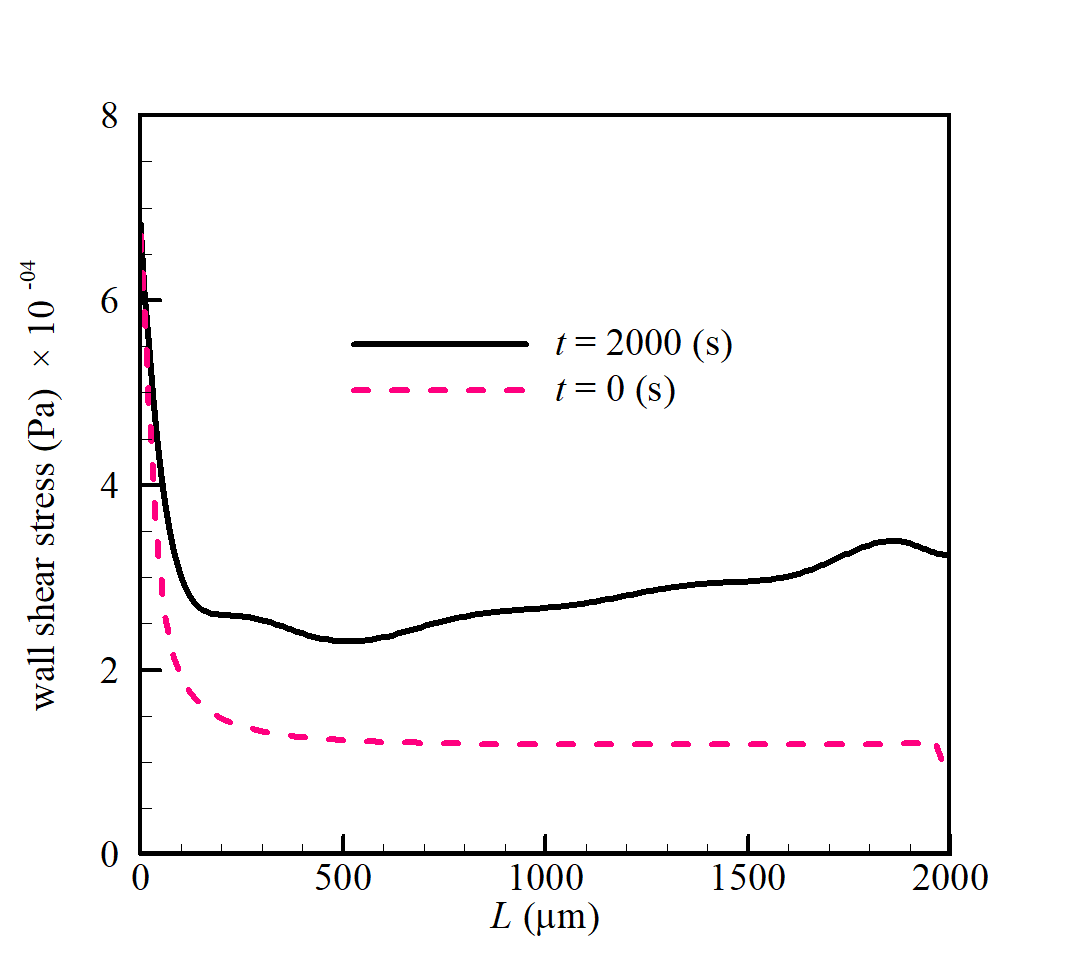
One of the important results obtained is that with the increase in speed and the passage of time, similar to Figure (1), an increase in shear stress can be observed in such a way that after the completion of the simulation, the shear stress at the end of the channel almost doubles. As mentioned earlier, the increase in shear stress causes the connection process to be less. According to figure (1), it can be seen that the reason for the reduction of the settlement at the beginning of the microchannel is the high shear stress in this area.